The kratom tree, known scientifically as Mitragyna speciosa, is a tropical evergreen native to Southeast Asia, celebrated for centuries in traditional practices for its versatile leaves. Understanding the kratom tree anatomy offers a window into the plant’s unique characteristics, revealing how each part contributes to its growth, survival, and cultural significance. From its sturdy roots anchoring it in humid jungles to the luscious leaves cherished by local communities, every component of the kratom tree tells a story of adaptation and utility. This blog takes you through the intricate structure of the kratom tree, providing a clear and engaging look at its roots, trunk, branches, leaves, flowers, and seeds, while shedding light on their roles in the plant’s life cycle.
Roots: The Foundation of the Kratom Tree
The kratom tree’s root system is the unsung hero of its anatomy, anchoring the plant in the often waterlogged soils of Southeast Asian rainforests. These roots are extensive, spreading both laterally and deep into the ground to provide stability for trees that can reach heights of up to 82 feet. The primary taproot drives downward, seeking water and nutrients, while a network of secondary and tertiary roots spreads outward, creating a robust foundation. This sprawling root system is crucial for surviving the region’s heavy rainfall and loose, nutrient-rich soils.
Roots also play a vital role in nutrient uptake. The kratom tree thrives in fertile, well-drained soils packed with organic matter, and its roots are adept at absorbing nitrogen, phosphorus, and other essential minerals. These nutrients fuel the tree’s growth, supporting the development of its broad leaves and sturdy trunk. In cultivation, farmers must ensure that the soil remains rich and moist, as the roots are sensitive to drought and poor soil quality. This dependency on specific conditions explains why kratom trees are challenging to grow outside their native tropical climates.
Interestingly, the roots of the kratom tree also contribute to its resilience. They can store water and nutrients, helping the tree endure brief periods of environmental stress. This adaptation is particularly useful in regions with seasonal flooding, where roots must cope with excess water while maintaining access to oxygen. The root system’s efficiency underscores why kratom trees are so well-suited to their native habitats, forming the backbone of the plant’s survival strategy.
The Trunk: A Pillar of Strength
Rising from the root system is the kratom tree’s trunk, a straight, smooth column that can grow up to three feet in diameter in mature specimens. The trunk’s outer bark is grey and smooth, providing a protective layer against pests, fungi, and harsh weather. Beneath this bark lies the vascular system, composed of xylem and phloem tissues, which transport water, nutrients, and sugars between the roots and the canopy. This system is critical for the tree’s growth, ensuring that every part receives the resources it needs to thrive.
The trunk’s wood is dense and durable, making it a valuable resource in some Southeast Asian communities where it is harvested for construction. However, the trunk’s primary role is structural, supporting the weight of the tree’s extensive branches and leaves. In young kratom trees, the trunk is slender and flexible, allowing it to sway in strong winds without snapping. As the tree matures, the trunk thickens, becoming a rigid pillar capable of withstanding the region’s tropical storms.
The trunk also serves as a storage site for nutrients, much like the roots. During periods of rapid growth or reproduction, the tree can draw on these reserves to fuel the development of new leaves or flowers. This ability to store and mobilize resources highlights the trunk’s role as more than just a structural component, it’s a dynamic part of the kratom tree’s anatomy, contributing to its adaptability and longevity.
Branches: The Framework of the Canopy
Extending from the trunk, the kratom tree’s branches form a sprawling canopy that captures sunlight and supports the plant’s photosynthetic engine. These branches grow in a pattern known as opposite branching, where pairs of branches emerge directly across from each other along the trunk. This arrangement maximizes the tree’s ability to spread its leaves evenly, ensuring efficient light capture in the dense, shaded understories of Southeast Asian forests.
The branches are woody and flexible in younger trees, becoming more rigid as the tree ages. They are covered in a thin layer of bark, similar to the trunk, which protects against environmental damage. The branches also house the vascular tissues that connect the leaves to the rest of the tree, facilitating the transport of water and nutrients upward and sugars downward. This continuous flow is essential for the tree’s growth and the production of its chemically rich leaves.
In cultivated settings, farmers often prune the branches to encourage bushier growth or to harvest leaves more easily. Pruning stimulates the tree to produce new shoots, increasing leaf yield. However, over-pruning can stress the tree, reducing its overall health. The branches’ role in supporting the canopy and facilitating nutrient transport makes them a critical part of the kratom tree’s anatomy, bridging the trunk and the leaves in a seamless network.
Leaves: The Heart of the Kratom Tree’s Utility
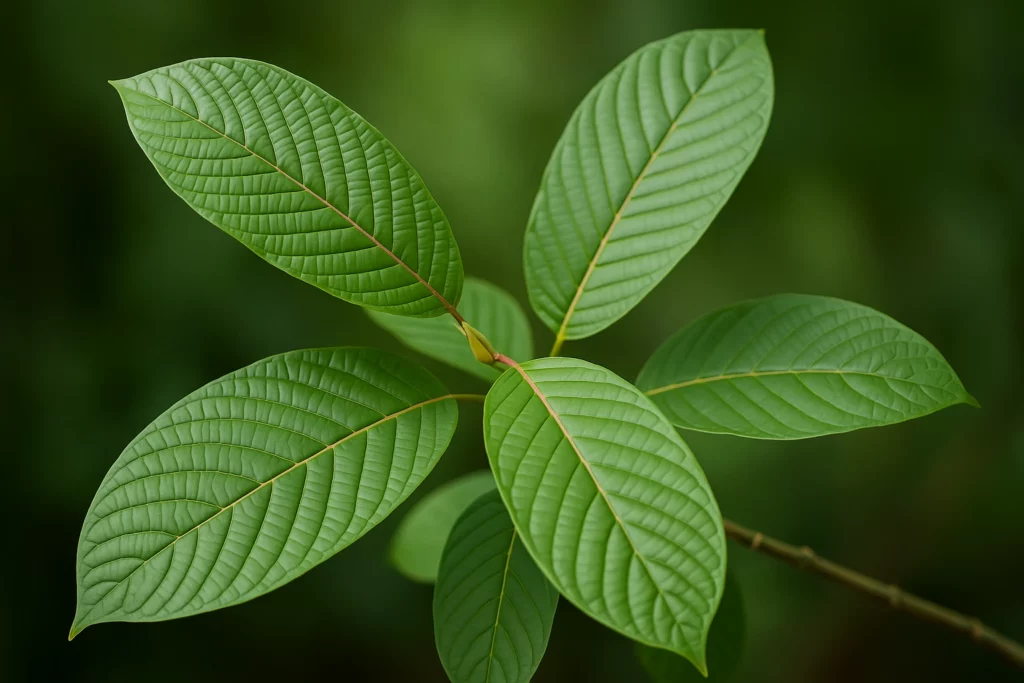
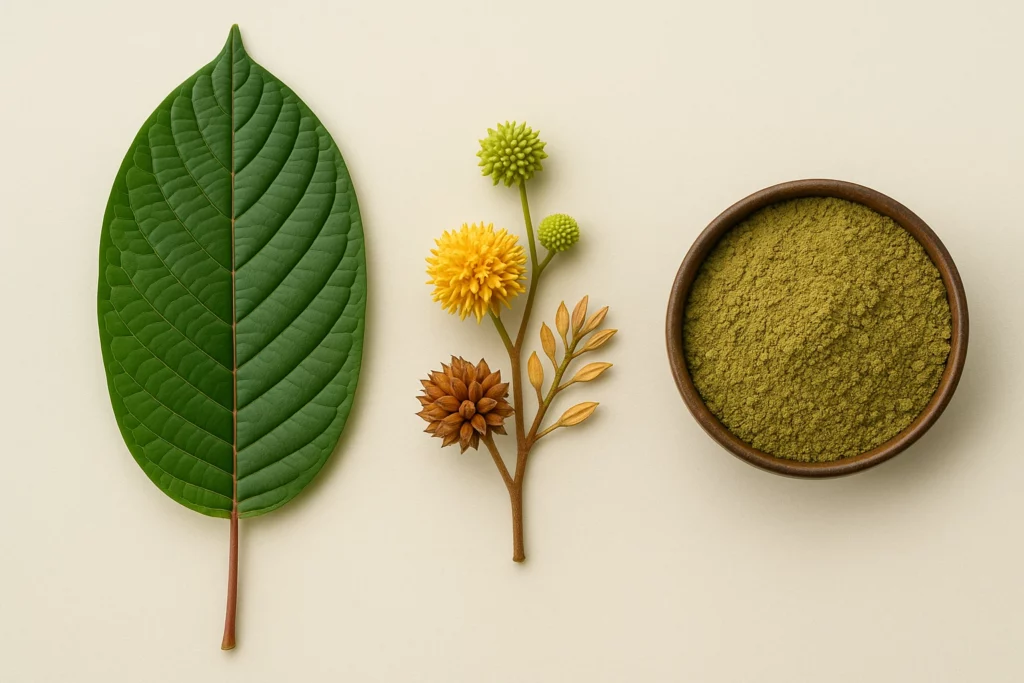
The leaves of the kratom tree are its most celebrated feature, revered for centuries in Southeast Asian cultures. These dark green, glossy leaves are broad, measuring 5.5 to 7.9 inches long and 2.8 to 4.7 inches wide, with an ovate-acuminate shape pointed at the tip and rounded at the base. Their glossy upper surfaces reflect sunlight, reducing water loss in the humid tropics, while the undersides are slightly paler, aiding in temperature regulation.
The leaves grow in an opposite pattern, like the branches, ensuring maximum exposure to sunlight. Each leaf is supported by a sturdy petiole, or stalk, which connects it to the branch and allows slight movement to optimize light capture. The leaf’s surface is veined with a network of veins that transport water, nutrients, and sugars, sustaining the photosynthetic process that powers the tree’s growth.
Kratom leaves are rich in alkaloids, particularly mitragynine and 7-hydroxymitragynine, which are concentrated in the leaf veins. These compounds are responsible for the leaves’ significance in traditional practices, where they are chewed fresh, dried and powdered, or brewed into tea. The alkaloid content varies depending on the leaf’s age, with mature leaves typically containing higher concentrations. This variability explains why farmers often time their harvests to maximize potency, picking leaves when they reach peak maturity.
The leaves’ vibrant green colour is due to chlorophyll, the pigment that drives photosynthesis. As the leaves age, they may turn yellowish before falling, a natural part of the tree’s cycle. In cultivation, growers monitor leaf color and texture to assess the tree’s health, as changes can indicate nutrient deficiencies or environmental stress. The leaves’ role as both a photosynthetic powerhouse and a source of bioactive compounds makes them the centerpiece of the kratom tree’s anatomy.
Flowers: The Reproductive Marvels
The kratom tree’s flowers are less prominent than its leaves but equally fascinating. These tubular, cream-coloured flowers form in dense, spherical clusters called inflorescences, which emerge at the ends of branches. Each inflorescence contains 80 to 100 small, bisexual flowers, each with a pistil and five stamens, allowing the tree to self-pollinate or cross-pollinate with the help of insects like bees.
The flowers begin as small, green buds, gradually developing into bell-shaped structures known as campanulate corollas. These give the inflorescence a distinctive spiked appearance, adding to the tree’s aesthetic appeal. Each flower contains an inferior ovary with two chambers, housing numerous ovules that can develop into seeds. The flowering process is seasonal, typically triggered by environmental cues like changes in daylight or temperature, though the exact mechanisms remain understudied.
Flowering is a resource-intensive process, requiring significant energy and nutrients. The tree draws on reserves stored in its roots and trunk to support the development of flowers, which eventually give way to seed pods. In traditional settings, flowers are rarely harvested, as the leaves are the primary focus. However, the flowers’ role in reproduction ensures the kratom tree’s survival, making them a critical component of its anatomy.
Seeds and Seed Pods: The Next Generation
After successful pollination, the kratom tree’s flowers develop into seed pods, which are small, oval capsules containing numerous tiny seeds. These pods are green when immature, turning brown as they dry and split open to release the seeds. The seeds are lightweight and winged, designed for dispersal by wind or water, which helps the tree colonize new areas in its native habitat.
Kratom seeds are notoriously difficult to germinate, with low success rates even in ideal conditions. They require fresh, moist environments and must be planted soon after harvesting, as they lose viability quickly. This challenge makes propagation by cuttings a more common practice among growers. When successful, seed germination can take weeks, with seedlings requiring careful attention to moisture and temperature to survive.
The seed pods and seeds represent the kratom tree’s reproductive future, ensuring genetic diversity and the potential for new trees to take root. In cultivation, farmers may collect seeds to experiment with new strains or to expand their plantations, though the process is labour-intensive. The seeds’ delicate nature underscores the tree’s reliance on its robust vegetative growth to thrive in the wild.
Bark and Cambium: The Protective Layers
The bark of the kratom tree, covering both the trunk and branches, is a smooth, grey shield that protects the plant from external threats. This outer layer guards against physical damage, pests, and pathogens, while also reducing water loss in the humid tropics. Beneath the bark lies the cambium, a thin layer of living cells responsible for the tree’s growth in diameter. The cambium produces new bark and wood, allowing the trunk and branches to thicken over time.
The bark’s smooth texture in young trees becomes slightly rougher with age, developing small fissures that add character without compromising function. In some Southeast Asian communities, the bark is used in traditional practices, though it is less common than leaf-based preparations. Its primary role, however, is protective, ensuring the tree’s vascular system remains intact and functional.
The cambium is particularly sensitive to damage, as any disruption can impair the tree’s ability to grow or transport nutrients. Farmers must take care when pruning or harvesting to avoid injuring this layer. The bark and cambium together highlight the kratom tree’s resilience, providing a durable barrier that supports its long-term survival.
The Kratom Tree’s Adaptations to Its Environment
The kratom tree’s anatomy is a masterclass in adaptation, tailored to the challenges of its native Southeast Asian environment. Its extensive root system thrives in wet, nutrient-rich soils, while the sturdy trunk and branches support a canopy designed to capture limited sunlight in dense forests. The glossy leaves maximize photosynthesis while minimizing water loss, and the flowers and seeds ensure reproductive success in a competitive ecosystem.
These adaptations reflect the tree’s evolutionary journey, shaped by centuries of surviving in tropical rainforests. The kratom tree’s ability to store nutrients in its roots and trunk allows it to endure seasonal flooding or drought, while its opposite branching and leaf arrangement optimize light capture. These features make the kratom tree a remarkable example of botanical engineering, perfectly suited to its environment.
Cultivation and the Role of Anatomy
Understanding the kratom tree anatomy is essential for successful cultivation, whether in its native range or in controlled environments. Growers must consider the tree’s need for rich, moist soil to support its roots, and regular pruning to maintain healthy branches and leaves. Temperature is another critical factor, as the tree prefers warm conditions between 73°F and 86°F, with growth slowing below 68°F.
Container-grown kratom trees require frequent irrigation and fertilization to mimic the nutrient-rich soils of their natural habitat. The leaves, being the primary harvestable part, demand careful monitoring to ensure optimal alkaloid content. Farmers often adjust harvesting times based on leaf maturity, as younger leaves may have different properties than older ones. The anatomy of the kratom tree guides every aspect of its cultivation, from soil preparation to harvest timing.
Cultural Significance of the Kratom Tree
Beyond its physical structure, the kratom tree holds deep cultural significance in Southeast Asia. Its leaves have been used for centuries in social and religious contexts, from welcoming guests to honouring ancestors. The tree’s anatomy, particularly its leaves, has made it a symbol of resilience and utility in communities where it grows. Understanding the tree’s parts deepens appreciation for its role in these traditions, connecting its physical form to its cultural legacy.
The kratom tree’s anatomy also informs its preparation methods. Fresh leaves are often chewed directly, while dried leaves are ground into powder or brewed into tea. The choice of preparation depends on the leaf’s properties, which vary with age and environmental conditions. This connection between anatomy and use underscores the tree’s versatility and enduring value.
Frequently Asked Questions About Kratom Tree Anatomy
Q: What is the most important part of the kratom tree’s anatomy?
A: The leaves are often considered the most important part due to their cultural and traditional significance in Southeast Asia. They are the primary part harvested for their alkaloid content, which drives the tree’s value in traditional practices. However, every part, from roots to seeds, plays a critical role in the tree’s survival and growth.
Q: How tall can a kratom tree grow, and how does its anatomy support this height?
A: A kratom tree can reach heights of up to 82 feet. Its sturdy trunk provides structural support, while the extensive root system anchors it firmly in the soil. The branches form a wide canopy, distributing weight evenly, which helps the tree maintain stability as it grows taller.
Q: Why are kratom seeds so difficult to germinate?
A: Kratom seeds lose viability quickly after harvesting and require specific conditions, such as high humidity and fresh, moist soil, to germinate successfully. Their winged structure aids dispersal but makes them delicate, contributing to low germination rates even in ideal environments.
Q: How does the kratom tree’s root system adapt to its environment?
A: The root system is extensive, with a deep taproot and sprawling secondary roots that anchor the tree in loose, wet soils. It also stores water and nutrients, helping the tree survive seasonal flooding or brief droughts common in Southeast Asian rainforests.
Q: Can the bark or trunk of the kratom tree be used like the leaves?
A: While the bark is occasionally used in some traditional practices, it is far less common than the leaves. The bark’s primary role is protective, shielding the tree from pests and environmental damage, while the trunk supports the tree’s structure and stores nutrients.
Q: How do environmental factors influence kratom tree anatomy?
A: Environmental factors like humidity, soil quality, and sunlight shape the tree’s anatomy. For example, the glossy leaves reduce water loss in humid climates, while the opposite branching pattern maximizes light capture in shaded forests, ensuring efficient growth.
Conclusion
As interest in the kratom tree grows globally, understanding its anatomy becomes increasingly important. Whether for traditional use, cultivation, or scientific study, the tree’s roots, trunk, branches, leaves, flowers, and seeds offer a wealth of information about its biology and potential. By appreciating the intricate interplay of these parts, we gain a deeper respect for the kratom tree’s complexity and its place in both nature and culture.
The kratom tree’s anatomy is a testament to its resilience and adaptability, qualities that have allowed it to thrive in challenging environments for centuries. As we continue to explore its structure and functions, we uncover new layers of its story, from the roots that anchor it to the leaves that define its legacy. This remarkable plant invites us to look closer, to understand its parts, and to marvel at the intricate design that makes it one of nature’s most fascinating creations.