One of humanity’s oldest spiritual and healing traditions has woven plant medicine into the very fabric of human culture for tens of thousands of years. Long before the word “medicine” carried clinical connotations, indigenous communities around the world turned to shamans (those gifted individuals who could walk between worlds) to restore balance, cure illness, and reveal hidden knowledge.
This ancient practice, known as shamanism, treated plants not as mere substances but as teachers, allies, and sacred beings with their own intelligence and spirit. Archaeological evidence from Siberia to the Andes shows that humans have intentionally altered consciousness with plants for at least 30,000 years, and in nearly every case the person guiding the experience was a shaman or shaman-like figure.
What Makes Shamanism Unique in Healing
At its core, shamanism is an animistic worldview. Everything (rivers, mountains, animals, and especially plants) possesses consciousness or spirit. A healer does not simply harvest a leaf or brew a root. The healer first asks permission, offers gratitude, and builds relationship. This foundational respect changes the entire encounter with plant medicine. The same herb picked with ceremony and song carries a different energy than one collected mechanically. Practitioners across continents have insisted for centuries that the spirit of the plant determines its efficacy as much as its chemical constituents do.
This perspective is not poetic metaphor. It is practical epistemology. A Shipibo healer will tell you that the plant must agree to help, otherwise the brew will be weak or even harmful. In the Himalayas, amchis who prepare Soma-like medicines first recite mantras for hours to awaken the deva residing in each ingredient. The belief is universal: plants are persons, and healing is always relational.
Ayahuasca and Amazonian Shamanism
In the Amazon basin, shamanism and plant medicine reach their most visible expression through ayahuasca ceremonies. The word ayahuasca itself comes from Quechua and means “vine of the soul” or “vine of the dead.” Amazonian shamans, often called ayahuasqueros or curanderos, spend years (sometimes decades) apprenticing under elder teachers.
The Role of Icaros and Healing Songs
They represented hundreds of icaros, the melodic healing songs believed to direct the medicine and call protective spirits. During ceremony, participants drink the brewed combination of Banisteriopsis caapi vine and Psychotria viridis leaves under the shaman’s guidance. The shaman remains mostly sober, singing and shaking leaf bundles to navigate the visionary terrain for the group. The role is not passive facilitation but active guardianship of everyone’s soul journey.
The icaros themselves are considered living entities. A master ayahuasquero does not “make up” songs. He or she receives them directly from plant spirits during dieta or in dreams. Some icaros are thousands of years old, passed orally through generations, while others emerge spontaneously when a new plant ally is met. Researchers who have recorded and analyzed these songs note that their rhythmic structure and tonal patterns often mirror the molecular geometry of the plants being invoked (an observation that continues to puzzle both ethnobotanists and acoustical engineers).
San Pedro and Andean Traditions
Similar patterns appear across continents. In the Andes, Quechua and Aymara healers work with San Pedro cactus (Echinopsis pachanoi), a columnar cactus used for millennia in healing and divination.
The Mesa and Sacred Space
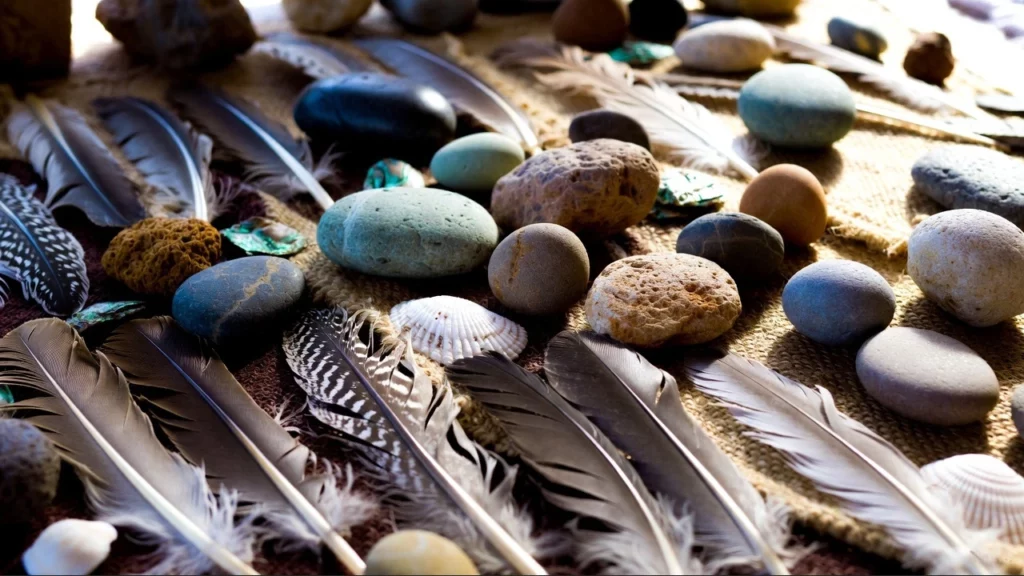
The mesa, or altar, of a San Pedro healer contains staffs, stones, shells, and other power objects that represent alliances with mountain spirits and ancestors. Before offering the brewed cactus to a patient, the healer opens sacred space by calling the apus (mountain spirits) and pachamama (earth mother). The ceremony often lasts all night under star-filled skies, with participants processing deep emotional material while the healer interprets visions and removes energetic blockages.
The mesa is a living cosmology in miniature. Each object has been “fed” with offerings of coca leaves, wine, or perfume over years, growing in power. Many healers inherit parts of their mesa from their teacher at death, creating direct energetic lineages that can stretch back centuries. To sit in front of an ancient mesa is to feel a palpable field of energy that participants describe as both protective and humbling.
North American and Mexican Indigenous Practices
In North America, many First Nations and Native American traditions employ plant medicines within ceremonial containers supervised by elders or medicine people who function in ways strikingly similar to shamans elsewhere.
Peyote, Psilocybin Mushrooms, and Mazatec Veladas
The Lakota use sage, sweetgrass, cedar, and tobacco in sweat lodge ceremonies, while some Plains tribes historically worked with peyote in the Native American Church. Among the Mazatec of Oaxaca, Mexico, María Sabina became famous in the mid-20th century for her veladas (night-long healing ceremonies using Psilocybe mushrooms). She described the mushrooms as “children” or “saints” who spoke directly to her in the Mazatec language, revealing diagnoses and guiding the healing process.
María Sabina’s veladas followed a precise structure: cleansing with copal incense, prayers in Mazatec and sometimes Spanish, then ingestion of paired mushrooms (always in pairs, because “they get lonely otherwise”). The ceremony would continue until dawn, with the curandera singing and massaging patients to help release blocked emotion. Her fame brought outsiders, including Western researchers and celebrities, but she always maintained that the mushrooms lost power when used for curiosity rather than true healing need.
Understanding Illness Beyond the Physical Body
What unites these diverse traditions is the understanding that illness often originates beyond the physical body. A person might suffer from susto (soul loss caused by fright), mal aire (bad wind), or envidia (energetic attack from jealousy). Plant medicines, under shamanic guidance, help retrieve lost soul fragments, clear intrusive energies, or realign the patient with their destiny. The shaman enters altered states (often with the aid of the same plants given to patients) to diagnose and treat on multiple levels simultaneously.
Shamans also recognize what they call “spiritual illnesses” that manifest physically: a person who violates taboo may develop cancer; someone who betrays community trust may suffer chronic pain until restitution is made. The plant medicine ceremony becomes a truth-telling space where these underlying contracts are revealed and renegotiated. Healing, in this view, is never just about the individual. It ripples outward to family, community, and land.
The Long Road to Becoming a Shaman
The training of a shaman rarely follows a casual path.
Shamanic Illness and the Dieta Tradition
In Siberia, among the Buryat, Evenk, and Sakha peoples, future shamans often endure a period of intense crisis called “shamanic illness.” They may experience visions, physical pain, or psychological breakdown that eventually resolves into clarity and power. Amazonian traditions require rigorous dietas (periods of isolation in the jungle consuming only specific plants while avoiding salt, sugar, sex, and strong emotions). Each dieta forges an alliance with a particular plant spirit. A curandero might complete dozens of these retreats over a lifetime, gradually building an internal garden of plant allies they can call upon during ceremony.
During a traditional dieta, the apprentice lives in a tambo (small jungle hut) far from the village, eating only bland foods like plantains and fish without seasoning. The chosen master plant (toé, chirisanango, bobinsana, or one of hundreds of others) becomes both teacher and taskmaster. Many dieters report vivid dreams in which the plant appears as a person who instructs, tests, and sometimes disciplines them. Emerging from a successful dieta, the healer gains not only new icaros but an embodied relationship that lasts for life.
The Universal Power of Sound in Shamanism
Music and sound play central roles in shamanic plant medicine work worldwide.
Drums, Icaros, and Songlines
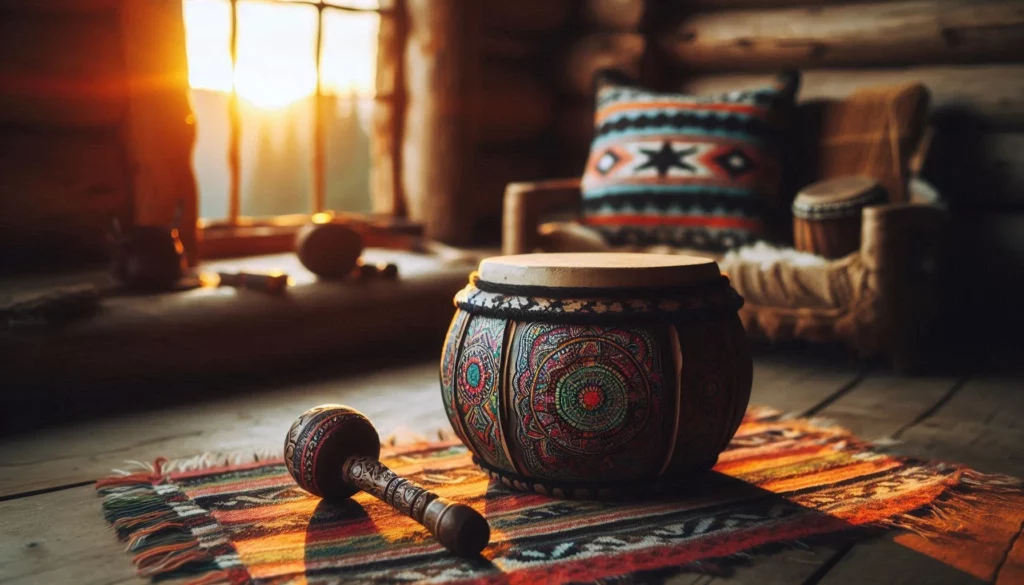
Siberian shamans beat drums to mimic the heartbeat of the earth and ride the sound into other realms. Shipibo healers in Peru use intricate geometric icaros that reportedly correspond to the visual patterns seen on ayahuasca. Aboriginal Australian songlines connect landscape, story, and healing plants across vast distances. The shaman’s voice becomes a bridge, carrying intention and restructuring energy fields.
In Mongolia and Tuva, throat-singing shamans produce multiple overtones simultaneously, creating the sensation of several voices emerging from one throat. These harmonics are believed to open portals and call helping spirits. Similarly, among the Q’eros of Peru, the conch-shell trumpet and panpipes are played in specific sequences that mirror the zigzag energy lines said to run through the Andes. Sound is never decoration. It is medicine in its own right.
Journeying Between Worlds
Perhaps the most misunderstood aspect of shamanism is the concept of journeying. In many traditions, the shaman’s spirit leaves the body to retrieve information or power from non-ordinary reality.
The World Tree and the Rainbow Bridge
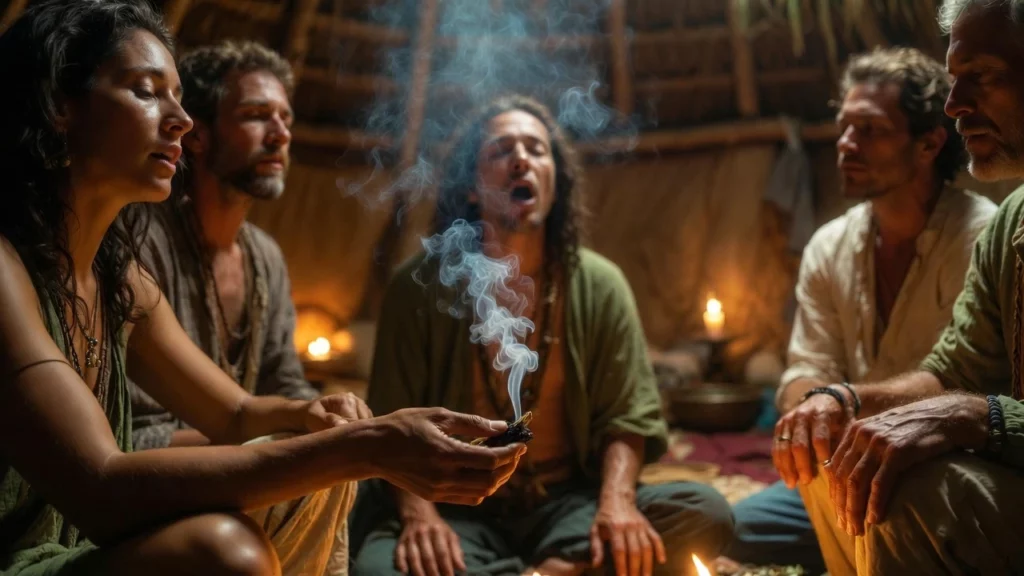
Mongolian shamans describe climbing the World Tree to reach upper realms or descending to lower worlds through the roots. South American vegetalistas speak of traveling on the arcana, the rainbow bridge formed by ayahuasca. These journeys require protection (hence the use of tobacco smoke, rattles, feathers, and songs to create sacred space and ward off unwanted entities).
Experienced shamans across traditions consistently describe three distinct cosmological layers that the soul navigates:
- Middle World – The spiritual dimension of ordinary reality; the energetic overlay of our physical world where lost objects, intrusive energies, or past events can be tracked and cleared
- Lower World – Typically earthy, lush, and populated by power animals and plant spirits; perceived as benevolent and healing, not “hellish” as in Western dualism
- Upper World – Ethereal and light-filled; home to ascended teachers, ancestors in human or light-body form, and higher guidance
Successful journeying depends on several non-negotiable principles that shamans follow regardless of culture:
- Clear intention set before departure (vague curiosity invites interference)
- Protective allies (power animals, plant spirits, or guardian ancestors) always present
- Use of rhythmic sound (drumming, rattling, or icaros) to maintain the trance state
- Return through the exact same “portal” used to leave, ensuring full re-integration
- Immediate grounding upon return (smoking tobacco, eating food, touching earth) to avoid disorientation or soul loss
Women in Shamanic Traditions
Women have always held prominent roles in shamanic traditions, though colonial records often erased their presence.
From Korean Mudang to Shipibo Onanya
In Korea, mudang (mostly women) perform gut ceremonies that can last days, channeling spirits and ancestors. Among the Shipibo-Conibo of Peru, many of the most respected ayahuasqueros are women, particularly elder onanya who specialize in healing female conditions. In parts of West Africa, women initiate into secret societies that guard powerful plant knowledge passed down matrilineally.
In the Peruvian Amazon, elder women known as onanya or meraya often surpass men in visionary capacity because, as they explain, “women bleed but do not die, so we understand life and death more intimately.” Their icaros tend to be softer and more melodic, focusing on emotional and uterine healing. Many of today’s most sought-after indigenous facilitators in retreat settings are grandmothers in their seventies and eighties who began dieting plants as children.
Colonial Impact and Modern Resurgence
The arrival of European colonizers dramatically disrupted indigenous shamanic systems. Plants like tobacco, coca, and peyote were demonized, ceremonies outlawed, and shamans persecuted as witches. Yet many traditions survived underground or in remote regions.
Revival, Appropriation, and Ethical Questions Today
In recent decades, a complex resurgence has occurred. Some indigenous communities cautiously share their knowledge with outsiders, while others maintain strict boundaries. Simultaneously, non-indigenous people have trained with traditional elders and brought adapted forms back to urban settings. This cross-cultural exchange raises important questions about appropriation, lineage, and safety.
The Shipibo, for example, have created the Alliance of Shipibo Healers (Alianza de Medicos Shipibo) to regulate who can legitimately claim training in their tradition. Similar councils now exist among the Q’eros, the Lakota peyote roadmen, and the Bwiti of Gabon. These bodies are attempting to protect both cultural integrity and participant safety in an era when weekend “shamanic” trainings proliferate online.
Why the Plants Are Calling Now
Contemporary practitioners (whether indigenous elders continuing unbroken lineages or careful students of those lineages) often emphasize that the plants themselves are now calling people. Many report that teacher plants actively seek those ready to listen, especially as global ecosystems face collapse. The message appears consistent across traditions: return to relationship, remember reciprocity, heal the human-nature bond.
From the Siberian taiga to the Australian outback, elders speak of a quickening: the spirit world is pressing closer because the earth herself is wounded. Amazonian shamans describe visions of the forest bleeding and asking humans for help. The resurgence of interest in plant medicine is thus understood less as a trend and more as an emergency response coordinated by the plants themselves.
Frequently Asked Questions About Shamanism and Plant Medicine
Q: Is shamanism a religion?
A: No, shamanism is not a formalized religion with dogma or scripture. It is a set of practices and an animistic worldview found across thousands of cultures. It can coexist with indigenous religions, Christianity, Buddhism, or no religion at all.
Q: Are all plant medicines psychoactive or hallucinogenic?
A: Not at all. While ayahuasca, peyote, and psilocybin mushrooms are well-known entheogens, many master plants used in shamanic traditions (such as bobinsana, una de gato, or chiric sanango) have little or no psychoactive effect. Their “teaching” happens through dreams, subtle energy, or long-term physiological changes rather than visions.
Q: Can anyone become a shaman?
A: In traditional societies, no. Shamans are usually chosen by the spirits through hereditary lineage, near-death experiences, or unmistakable signs during the “shamanic illness.” Modern non-indigenous practitioners may train for decades, but most indigenous elders insist that true shamanic power is bestowed, not earned through coursework alone.
Q: Is “soul retrieval” a real practice across cultures?
A: Yes. From the Inuit of the Arctic to the Q’ero of Peru and the sangoma of Southern Africa, healers describe retrieving lost soul fragments caused by trauma, fright, or violation. The symptoms of soul loss (depression, addiction, chronic emptiness) are remarkably consistent worldwide.
Q: How do indigenous communities feel about outsiders using their sacred plants?
A: Opinions vary widely. Some communities (such as certain Shipibo and Lakota groups) have created strict protocols or outright bans on non-indigenous participation. Others cautiously share when proper respect and reciprocity are demonstrated. Most agree that commercialization without lineage or community benefit is harmful.
Q: Is shamanism making a comeback because of tourism and retreats?
A: Tourism plays a role, but many elders say the plants themselves are calling people in response to global ecological and spiritual crisis. The increased interest is seen less as a fad and more as an emergency signal from the natural world.
Q: Are there risks in working with traditional plant medicines without a trained shaman?
A: Yes, significant ones: psychological destabilization, physical complications from improper preparation, or spiritual intrusion. Traditional systems evolved sophisticated safeguards (diet, ceremony, integration) that self-administration often ignores.
The Enduring Legacy of Shamanism in Plant Medicine
The role of shamanism in plant medicine practices, then, is not merely historical footnote but living orientation. It offers a framework where healing addresses body, mind, spirit, community, and land simultaneously. The shaman stands at the threshold, guiding others across while maintaining alliances with plant beings who have guided humanity since our earliest dreams.
As more people seek alternatives to conventional approaches, the ancient templates provided by shamanism continue to evolve. Ceremonies now occur in modern retreat centers, urban apartments, and hospital adjunct programs. Yet certain principles remain non-negotiable: respect for the plants, proper training of facilitators, integration support afterward, and recognition that these traditions belong first and foremost to the cultures that birthed them.
The story of plant medicine cannot be told without shamanism, just as shamanism cannot be separated from the green world that sustains it. From the Arctic tundra to the Amazon rainforest, from Siberian taiga to Andean highlands, humans have listened to plants through the medium of those rare individuals able to translate between worlds. That conversation, older than written language, continues wherever someone approaches a plant with humility, makes an offering, and truly listens.