



If you’ve ever felt lost reading a product description, confused by a forum thread, or unsure what a vendor actually means when they say “enhanced,” “horned,” or “AKA GMP,” this kratom glossary is built for you. Inside you’ll find 87 of the most common (and most misused) kratom terms, listed alphabetically and explained in clear, everyday language. Whether you’re experiencing kratom for the first time or you’ve been rotating strains for years, this page works as your instant reference and keep this page saved as your quick reference.
How to Use This Kratom Glossary
Brand new? Start with the core entries: Mitragyna speciosa, vein color, alkaloids, less is more, and toss and wash.
If you’re already familiar with the basics then use the Quick-Jump Alphabet to navigate straight to strain names or any other terms that you may be unsure about. Every definition is kept short, neutral, and accurate so you can understand it in seconds.
Quick-Jump Alphabet
A | B | C | D | E | F | G | H | I | J | K | L | M | N | O | P | R | S | T | U | V | W
A
7-Hydroxymitragynine (7-OH)
A minor but extremely potent alkaloid (usually 1–2 % of total alkaloid content). It binds much more strongly to mu-opioid receptors than mitragynine and is primarily responsible for the stronger analgesic effects in certain red strains and extracts.
Adulteration
The illegal addition of synthetic opioids, isolated alkaloids, or other drugs to kratom powder to artificially increase potency. Reputable vendors test every batch to guarantee purity.
Agonist
A compound that activates a receptor. Mitragynine and 7-OH act as partial agonists at mu-opioid receptors.
AKA (American Kratom Association)
The leading U.S. consumer advocacy organization that fights bans and created the GMP quality program.
AKA GMP
Good Manufacturing Practices certification from the American Kratom Association. Indicates strict processing, testing, and documentation standards.
Alkaloids
The active chemical compounds in kratom leaves. Over 40 have been identified; mitragynine and 7-hydroxymitragynine are the most abundant and best studied.
Analgesic
Pain-relieving. The property most associated with red-vein kratom and moderate-to-higher servings.
B
Bali
One of the oldest commercial strain names. Originally leaf shipped through Bali’s port (not necessarily grown there). Typically red-vein and relaxing.
Bentuangie
A fermented Indonesian red-vein kratom. The controlled fermentation darkens the powder and is said to enhance calming properties.
Biak-biak
Traditional Indonesian name for kratom.
Borneo
Kratom originating from the island of Borneo. Comes in red, green, and white vein varieties.
Burn
Community slang for taking a serving of kratom.
C
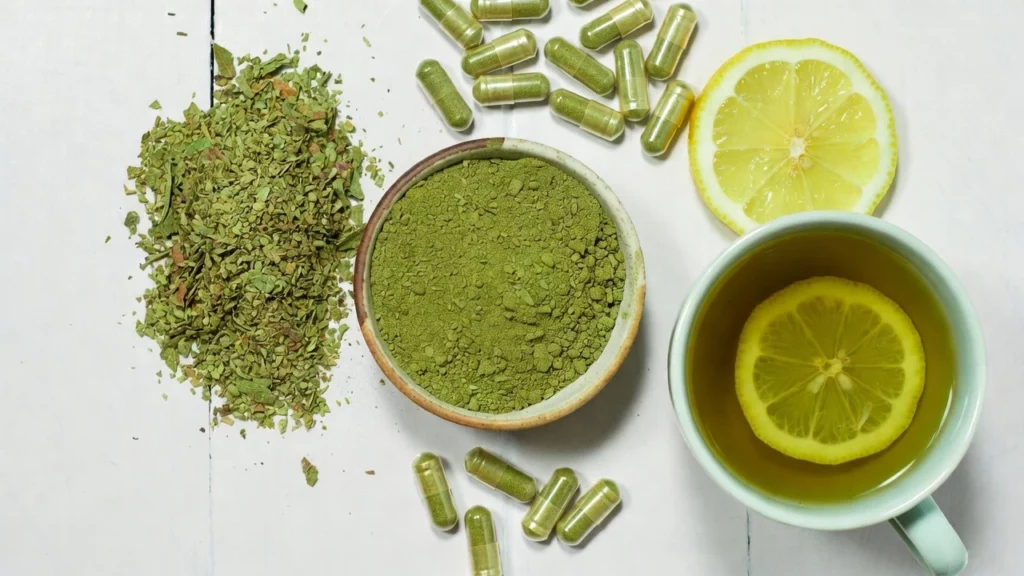
Capsules
Pre-measured kratom powder in vegetarian or gelatin capsules. Standard “00” capsules hold roughly 0.4–0.6 g. based on the density of the powder itself.
Crushed leaf
Dried leaves broken into small pieces rather than finely powdered. Popular for making tea or resin.
Cross-tolerance
Tolerance that develops between kratom and other mu-opioid agonists (including pharmaceutical opioids).
D
Daun ketum
Malay for “ketum leaf,” the everyday name for kratom in Malaysia.
Dependence
Physical adaptation from regular use. Abrupt cessation can produce mild withdrawal symptoms.
Dose / Serving
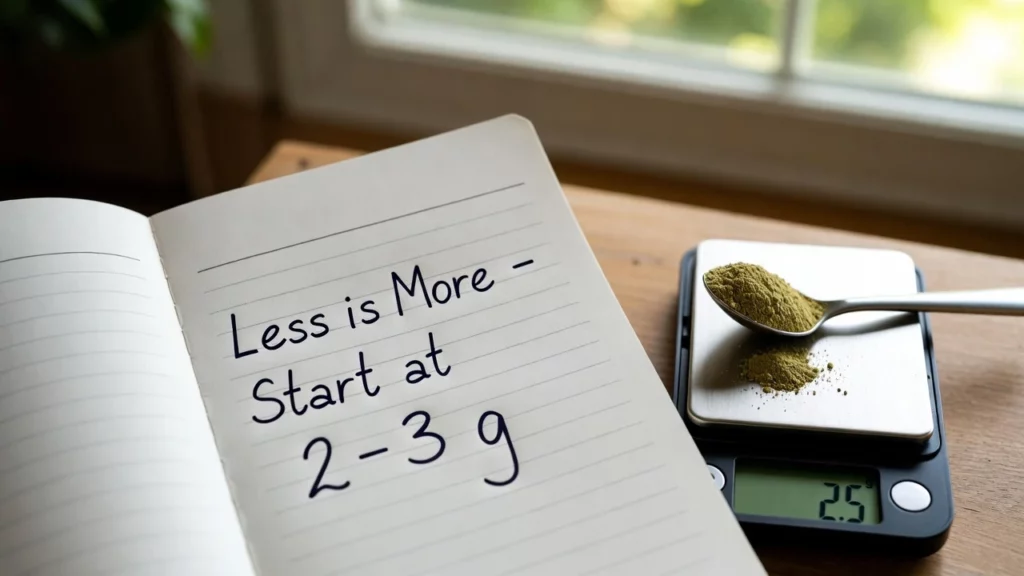
The amount taken at one time, always measured in grams on a scale (not teaspoons).
E
Elephant
Strain named for its unusually large leaves. Usually red or green from Malaysia or Indonesia.
Enhanced leaf
Plain powder with a measured amount of extract added back (e.g., 5 %, 10 %, 25 % enhanced).
Extract
Concentrated product made by boiling leaf into resin and then dried or reapplied. Strength is expressed as a ratio (10x, 50x, etc.).
F
Fermentation
Traditional process (especially for Bentuangie) where leaves are bagged and allowed to undergo controlled bacterial fermentation, changing color and alkaloid profile.
G
Gold / Yellow vein
Not a natural vein color. Created through special drying techniques or blending to produce a milder, balanced effect.
Green vein
Leaves harvested when the central vein is green. Generally considered the “balanced” vein with moderate energy and some relaxation.
H
Heavy metals
Testing for lead, arsenic, cadmium, and mercury. Responsible vendors publish results for every batch.
Horned / Horn
Leaves with small spike-like protrusions on the edges. Some farmers believe horned leaves have higher mitragynine content.
Hulu Kapuas
Rare strain from the Kapuas Hulu region along the Kapuas River in West Kalimantan, Indonesia.
I
Indo
Short for any kratom grown in Indonesia.
Ithang
Traditional name used in northern Thailand and Myanmar.
J
Jongkong
Growing region in West Kalimantan, Indonesia, known for earthy, long-lasting strains.
K
Kakuam
Another regional Thai/Myanmar name for kratom.
Kratom
The common name for Mitragyna speciosa and its prepared leaves.
L
Lab-tested
Confirmed by an independent third-party laboratory for alkaloid levels, heavy metals, and pathogens.
Less is more
Reminder that lower servings (2–4 g) often give cleaner stimulation, while higher servings become sedating.
M
Maeng Da
Thai for “pimp grade.” Originally the highest-quality leaf; now a marketing term for potent, selectively-bred strains.
Malay / Malaysian
Kratom grown in Peninsular Malaysia. Green Malay is especially prized for duration and balance.
Micronized
Powder ground to an ultra-fine consistency for faster onset and easier mixing.
Mitragyna speciosa
The botanical name of the kratom tree (Rubiaceae family).
Mitragynine
The primary alkaloid, usually 60–70 % of total alkaloid content. Drives most effects at typical servings.
N
Nausea
Common side effect from too large a starting serving or taking on an empty stomach.
P
Paynantheine
Second most abundant alkaloid; contributes to smooth-muscle relaxation.
Plateau
The point where increasing the serving stops improving effects and sharply increases side effects.
Powder
The standard form: dried leaves ground into fine flour.
R
Red vein
Leaves harvested when the central vein has turned red. Generally the most relaxing and analgesic vein color.
Resin
Thick, dark concentrate made by prolonged boiling of leaves or powder.
Rotation
Switching between different veins or strains to slow tolerance buildup.
S
Sedating
Calming, relaxing effects most associated with red veins and higher servings.
Speciogynine
Third most abundant alkaloid; also contributes to muscle relaxation.
Stem & Vein (S&V)
Stems and midribs only with lower alkaloid content; often used during tolerance resets.
Stimulating
Energizing and focus-enhancing effects most linked to white veins and low-to-moderate green servings.
Sumatra
Kratom from the Indonesian island of Sumatra (red, green, white available).
Sweet spot
Your personal ideal serving that gives maximum desired effects with minimal side effects.
T
T-break
Tolerance break: complete abstinence (usually 1–4 weeks) to restore sensitivity.
Tapering
Gradually lowering daily intake to ease withdrawal symptoms.
Tea
Traditional preparation: powder or crushed leaf steeped in hot water (often with citrus for better alkaloid extraction).
Thai
Kratom grown in Thailand; historically known for strong white and green varieties.
Thom
Southern Thai name for kratom leaf.
Tincture
Liquid extract in alcohol or glycerin base.
Tolerance
Reduced response to the same serving after repeated use.
Toss and wash
Placing powder in the mouth and washing it down with liquid: quick but gritty.
U
Unregulated
Kratom is largely unregulated in most countries, including Canada. This means products can vary widely in potency, purity, and labeling accuracy. Awareness of this fact is crucial for safe consumption.
V
Vein color
The color of the central vein at harvest (red, green, or white) that broadly predicts effect profile.
W
White vein
Young leaves with white veins; typically the most stimulating and mood-brightening.
Withdrawal
Mild-to-moderate symptoms (runny nose, irritability, insomnia, aches) after stopping regular use.
Wobbles
Unpleasant eye-focus instability caused by too high a serving or strong extracts.
Frequently Asked Kratom Questions
Q: What are the three main vein colors and what do they do?
A: Red = most relaxing and analgesic, Green = balanced energy and calm, White = most stimulating and mood-brightening.
Q: Why do people say “less is more” with kratom?
A: Lower servings (2–4 g) usually produce clean stimulation and focus. Higher servings (6 g+) shift toward sedation and increase side effects like nausea or wobbles.
Q: Is kratom legal in Canada?
A: Yes. As of 2026 it is completely legal to purchase, possess, and sell in Canada. Health Canada treats it as a natural health product with no approved medical claims.
Q: How fast does tolerance build?
A: Noticeable tolerance can appear in 3–7 days of daily use for many people, sometimes even faster with high servings.
Q: What does “lab-tested” really mean?
A: An independent third-party laboratory has tested the batch for alkaloid percentages, heavy metals (lead, arsenic, cadmium, mercury), and microbial contaminants (salmonella, E. coli, mold).
Q: Do all red strains feel sedating?
A: Most do, but individual body chemistry and alkaloid ratios cause variation. Some reds feel surprisingly balanced.
Q: Can kratom cause a positive drug test?
A: Standard employment drug tests (5-panel, 10-panel) do not detect kratom. Only rare specialized tests screen for mitragynine.
Q: How should I store kratom long-term?
A: Airtight container in a cool, dark place. Properly stored powder stays potent for 2–3 years or longer.
Conclusion: Why Knowing the Language Matters
The kratom world can feel like its own dialect at first. Once you understand the real meaning behind “vein color,” “less is more,” “stem & vein,” or “lab-tested,” you stop guessing and start making informed choices. This glossary isn’t about memorizing 87 words; it’s about giving you the confidence to read a label, spot low-quality marketing, ask the right questions, and recognize truly clean, properly-tested leaf when you see it.
Keep this page bookmarked. The terms will stay the same even as new strains and trends appear in 2027 and beyond. Start low, rotate strains, buy only from vendors who publish fresh third-party lab results, and always listen to your body.
Disclaimer
The information provided in this blog is for educational and informational purposes only and is not intended to serve as medical advice, diagnosis, or treatment. Kratom (Mitragyna speciosa) is not approved by the U.S. Food and Drug Administration (FDA), Health Canada, or any other regulatory health authority for the prevention, treatment, or cure of any medical condition, disease, or disorder.
The effects of kratom vary widely between individuals and may include both desired effects and unwanted side effects such as nausea, dizziness, constipation, dependence, or in rare cases more serious adverse reactions. Regular or heavy use can lead to physical dependence, tolerance, and withdrawal symptoms upon cessation. Kratom has opioid-like properties due to its interaction with mu-opioid receptors and carries a risk of misuse.
Individuals who are pregnant, breastfeeding, under 18, have pre-existing medical conditions, or are taking prescription medications (especially opioids, sedatives, CNS depressants, or MAO inhibitors) should avoid kratom entirely or consult a qualified healthcare professional first, as dangerous and potentially life-threatening interactions are possible. The authors and publishers of this glossary assume no liability for any injury, loss, or damage incurred as a result of using or relying on the information contained herein.