

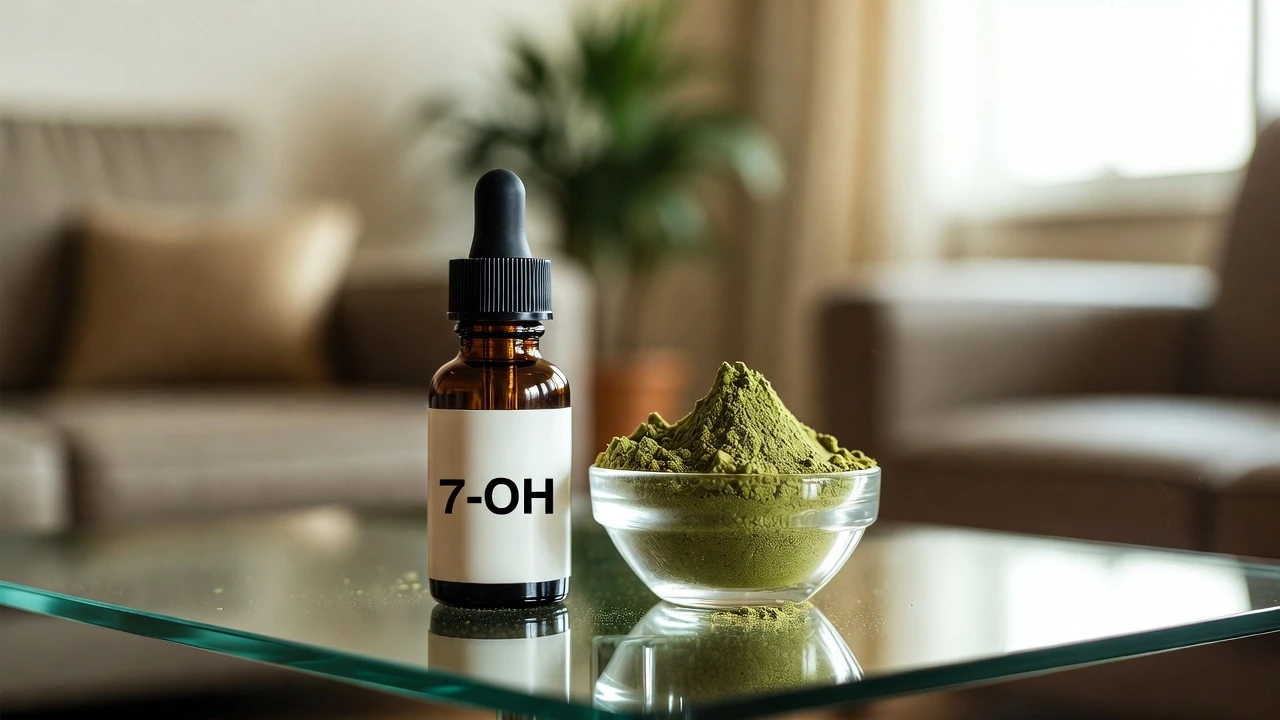

The world of kratom has never been quiet, but few topics generate as much heated discussion as 7-hydroxymitragynine products. Often shortened to 7-OH or 7-hydroxymitragynine, this single alkaloid has become the focal point of an ongoing tug-of-war between enthusiastic users, cautious regulators, skeptical scientists, and concerned public-health advocates.
While regular kratom leaf contains only trace amounts of this compound (usually well under 0.2 % of total alkaloid content), modern extraction and concentration techniques have made it possible to buy products that are dozens or even hundreds of times more potent. That dramatic shift is exactly why 7-hydroxymitragynine products sit at the heart of today’s most polarizing kratom conversation.
What Exactly Is 7-Hydroxymitragynine?
Mitragyna speciosa, the tropical tree better known as kratom, contains more than forty identified alkaloids. Two of them, mitragynine and 7-hydroxymitragynine, are considered the main actors behind most of kratom’s noticeable effects. Mitragynine is by far the most abundant, typically making up 60-70 % of the total alkaloid fraction in traditional leaf material. 7-Hydroxymitragynine, on the other hand, is present in extremely small quantities in the raw leaf, often less than 2 % of the mitragynine content.
Despite its low natural concentration, research conducted over the past two decades has repeatedly shown that 7-hydroxymitragynine is significantly more potent at mu-opioid receptors than mitragynine itself. Some studies using animal models have estimated it to be roughly 13-17 times stronger than morphine on a milligram-for-milligram basis at those receptors, while mitragynine is considerably weaker and only partially activates the same pathways.
This potency difference is the reason isolated or concentrated 7-hydroxymitragynine products have exploded in popularity among experienced users looking for stronger or faster-acting effects with much smaller serving sizes.
How Are Concentrated 7-Hydroxymitragynine Products Made?
Traditional dried kratom powder is essentially ground leaf. Even the strongest natural strains rarely exceed 1.5-2 % total mitragynine, and the 7-OH content stays proportionally tiny. To create products marketed as “7-OH” or “7-hydroxymitragynine-enhanced,” manufacturers use one of several approaches:
- Alkaloid extraction followed by deliberate oxidation of mitragynine into 7-hydroxymitragynine in the lab.
- Selective purification of naturally occurring 7-OH from massive quantities of leaf.
- Full-spectrum extracts spiked with isolated 7-hydroxymitragynine obtained through either of the above methods.
The end result is typically a tablet, capsule, or liquid that contains anywhere from 10 mg to 100 mg or more of 7-hydroxymitragynine per serving, compared to the 0.02-0.2 mg someone might ingest from an equivalent traditional dose of plain leaf. That represents a potency increase of 50- to 500-fold, which fundamentally changes the risk-to-benefit equation for many observers.
Why Users Are Drawn to 7-Hydroxymitragynine Products
Among experienced members of the kratom community, the appeal is straightforward. Smaller serving sizes mean less material to swallow, faster onset, and, for some, more pronounced relief from discomfort or low mood. Because the compound interacts more directly and efficiently with opioid receptors, many report that low to moderate amounts feel closer to low-dose pharmaceutical opioids than traditional kratom ever did, yet without the same level of sedation or respiratory depression seen with classical opioids at equipotent doses.
These subjective differences have fueled a niche but passionate following, particularly among long-term plain-leaf users who feel they have developed tolerance and no longer respond as strongly to regular kratom powder.
The Safety Concerns That Alarm Critics
The same potency that attracts users is precisely what worries toxicologists, addiction specialists, and regulatory agencies. Several interrelated concerns dominate the critical side of the debate:
Higher Dependence and Withdrawal Potential
Because 7-hydroxymitragynine is a more efficient mu-opioid receptor agonist, many experts believe regular use carries a greater risk of physical dependence than traditional kratom. Anecdotal reports from users who have switched to concentrated products describe withdrawal symptoms that feel closer to low-dose opioid withdrawal (muscle aches, restlessness, insomnia, irritability) than the relatively mild discomfort sometimes associated with stopping plain-leaf kratom after years of daily use.
Narrower Safety Margin
Classical opioids become dangerous primarily because the dose needed for strong pain relief is not far removed from the dose that causes life-threatening respiratory depression. While 7-hydroxymitragynine appears to have a better therapeutic index than morphine or fentanyl in animal studies, the gap is considerably smaller than with mitragynine-rich leaf. That reduced margin leaves less room for error, especially when products are inconsistently labeled or when users combine them with other depressants.
Inconsistent Dosing and Labeling Accuracy
Unlike pharmaceutical medications, dietary supplements and botanical products sold online are not required to undergo rigorous third-party potency verification in most jurisdictions. Independent lab tests of various 7-hydroxymitragynine products have revealed actual content ranging from 20 % below to 300 % above the amount stated on the label. Such variability dramatically increases the chance of accidental overconsumption.
Lack of Long-Term Human Data
Virtually all of the existing safety research on 7-hydroxymitragynine comes from short-term animal studies or in vitro receptor binding assays. There are no controlled human trials examining chronic, high-dose exposure. Critics argue that introducing a semi-synthetic opioid agonist with potency in the morphine range into the gray-market supplement space, without that foundational research, is reckless.
The Current Legal Landscape in Canada and Elsewhere
Health Canada has never approved kratom (Mitragyna speciosa) for human consumption. The agency classifies the plant material as an unscheduled substance but has repeatedly stated that selling it as a food, natural health product, or ingestible item violates the Food and Drugs Act. Possession of plain leaf for personal use is not criminalized, but commercial distribution sits in a legal gray zone that has led to periodic seizures and warning letters.
Products that contain isolated or concentrated 7-hydroxymitragynine face even stricter scrutiny. Because they are no longer whole-plant material and because the primary alkaloid is significantly more potent, regulators in several countries have begun treating them as unapproved new drugs or controlled-substance analogues.
In the United States, the FDA has issued import alerts specifically targeting shipments of 7-hydroxymitragynine-containing products and has sent warning letters to companies marketing them. Some states, including Alabama, Arkansas, Indiana, Rhode Island, Vermont, and Wisconsin, have explicitly banned 7-hydroxymitragynine by name even while allowing plain-leaf kratom.
As of late 2025, Canada has not yet placed 7-hydroxymitragynine on the Controlled Drugs and Substances Act schedule, but border seizures of concentrated products have become more common, and Health Canada has publicly stated that products “containing high concentrations of 7-hydroxymitragynine” raise serious safety concerns and are not authorized for sale.
Ethical Questions Within the Kratom Community Itself
Interestingly, opposition to concentrated 7-hydroxymitragynine products is not limited to government agencies. A vocal segment of the longtime kratom advocacy community actively campaigns against them. Their arguments usually fall into three categories:
- Preservation of legal access: Advocates fear that high-profile adverse events linked to ultra-potent products will provide regulators with exactly the ammunition needed to ban kratom entirely, jeopardizing access to traditional leaf that millions use without incident.
- Departure from traditional use: Many point out that indigenous Southeast Asian cultures have used whole-leaf kratom for centuries with no historical precedent for isolating or concentrating 7-OH. They argue that modern concentrated products represent an entirely different substance with a different risk profile.
- Profit over safety: Some community members accuse certain vendors of prioritizing margins by creating addictive, high-priced products that keep customers coming back more frequently, rather than encouraging moderate, sustainable use of plain leaf.
Comparing Risks: Plain Leaf vs. Concentrated 7-Hydroxymitragynine Products
| Aspect | Traditional Kratom Leaf | Concentrated 7-OH Products |
|---|---|---|
| Primary active compound | Mitragynine (partial agonist) | 7-Hydroxymitragynine (full, high-affinity agonist) |
| Typical alkaloid content | 1-2 % mitragynine, <0.02 % 7-OH | 10-100+ mg pure or semi-pure 7-OH per dose |
| Onset | 30-60 minutes | 10-20 minutes |
| Dependence risk (perceived) | Low to moderate | Moderate to high |
| Reported withdrawal intensity | Generally mild | Often more opioid-like |
| Regulatory status (Canada) | Unauthorized for sale, not scheduled | Increasingly targeted for seizure |
| Labeling consistency | Variable but improving | Highly variable, frequent mislabeling |
Where the Science Stands Today
Although no large-scale, long-term human trials exist specifically for isolated 7-hydroxymitragynine, the pharmacological profile is reasonably well understood from receptor-binding studies and rodent research. Key established facts include:
- 7-Hydroxymitragynine is a potent mu-opioid receptor agonist with significant analgesic properties in animal pain models.
- It displays significantly less respiratory depression than morphine at equianalgesic doses in rats and mice.
- It also interacts with kappa and delta opioid receptors to a lesser degree, as well as adrenergic and serotonergic systems.
- Chronic administration in animals leads to tolerance and physical dependence, reversible by opioid antagonists.
What remains unknown is equally important: we do not have reliable data on cardiovascular effects at recreational human doses, potential for seizures (a concern raised with very high-dose mitragynine), liver enzyme interactions, or psychiatric risks with long-term daily use.
The Future of 7-Hydroxymitragynine Products
Three broad scenarios seem plausible over the next few years:
- Increasing regulation or outright bans in more jurisdictions, pushing the products fully underground.
- Responsible manufacturers voluntarily withdrawing high-potency isolates in favour of standardized full-spectrum extracts with capped 7-OH levels, in an attempt to preserve broader kratom access.
- Formal pharmaceutical development of 7-hydroxymitragynine or synthetic analogues as prescription analgesics, following the path once traveled by THC moving from illicit cannabis to dronabinol and later to whole-plant medical programs.

Frequently Asked Questions About 7-Hydroxymitragynine Products
Q: How much 7-hydroxymitragynine is in regular kratom powder?
A: In traditional dried kratom leaf, 7-hydroxymitragynine typically makes up less than 0.02 % of the total weight and usually less than 2 % of the total alkaloid content. A standard 5-gram dose of plain leaf contains roughly 0.5–2 mg of 7-OH at most.
Q: Is 7-hydroxymitragynine the same thing as an opioid?
A: It is a naturally occurring alkaloid that acts as a potent mu-opioid receptor agonist, so pharmacologically it functions like an opioid. However, it is not a synthetic opioid and is chemically distinct from morphine, fentanyl, oxycodone, etc.
Q: Are 7-hydroxymitragynine products legal to buy in Canada right now?
A: As of late 2025, Health Canada has not scheduled 7-hydroxymitragynine under the Controlled Drugs and Substances Act, but the agency considers concentrated products unauthorized for sale as foods or natural health products. Many shipments are seized at the border, and domestic vendors operate in a legal gray area.
Q: Can you overdose on 7-hydroxymitragynine products?
A: While animal studies suggest a wider safety margin than classic opioids, extremely high doses combined with other depressants (alcohol, benzodiazepines, etc.) have been linked to severe adverse events. Accurate dosing is critical because of inconsistent labeling.
Q: Do 7-hydroxymitragynine products show up differently on drug tests?
A: Standard 5- or 10-panel drug tests do not detect kratom alkaloids. Specialized tests for mitragynine/7-hydroxymitragynine exist but are rarely used outside of specific research or forensic settings.
Q: Is tolerance to plain-leaf kratom the same as tolerance to 7-OH products?
A: No. Because 7-hydroxymitragynine is a much stronger agonist, tolerance develops faster and at lower equivalent doses. Users often report that switching back to plain leaf after heavy 7-OH use feels ineffective for weeks.
Conclusion
7-Hydroxymitragynine products sit at a crossroads between botanical tradition and modern semi-synthetic pharmacology. They offer undeniable potency and efficiency to those who seek it, yet they introduce risks that even many longtime kratom supporters find unacceptable. The compound itself is neither inherently evil nor miraculously safe; it is simply far more powerful than the plant material most people associate with the name “kratom.”
For now, anyone considering these products must weigh the absence of regulatory oversight, the heightened dependence potential, and the very real possibility that today’s gray-market availability could disappear tomorrow. The debate is far from settled, and it likely will not be resolved by slogans or extremes. Only careful, transparent research and honest conversation stand any chance of charting a responsible path forward.
Disclaimer
The information provided in this blog is for educational and informational purposes only and does not constitute medical advice or health claims. Kratom and concentrated 7-hydroxymitragynine products are not approved by Health Canada, the U.S. FDA, or any major regulatory health authority worldwide for any therapeutic or medicinal purpose. These substances have not been evaluated through large-scale, long-term human clinical trials, and their safety profile in humans, especially with chronic or high-dose use remains incompletely understood.
7-Hydroxymitragynine is a potent mu-opioid receptor agonist with pharmacological properties similar to, though distinct from, traditional opioids. Regular or high-dose use of concentrated 7-hydroxymitragynine products carries a significantly greater risk of physical dependence, tolerance, and withdrawal symptoms that may resemble those of classical opioids compared to traditional kratom leaf.
Serious adverse effects, including respiratory depression, cardiovascular complications, seizures, liver injury, and life-threatening interactions with other central nervous system depressants (alcohol, benzodiazepines, opioids, etc.), are possible, particularly when dosing is inaccurate or when products are combined with other substances. Kratom and its derivatives may interact with numerous prescription and over-the-counter medications, and individuals with pre-existing medical conditions, pregnant or breastfeeding individuals, and those under 18 years of age should avoid use entirely.
The author, publisher, and any affiliated parties assume no responsibility or liability whatsoever for any direct, indirect, incidental, consequential, or special damages, injuries, or adverse outcomes that may result from the use or misuse of the information contained herein. Always consult a qualified healthcare professional before starting, stopping, or modifying use of any substance affecting the opioid system